


Boot Liner or Boot Mat: What Your Cargo Actually Decides
A boot liner and a boot mat differ in exactly one way: the liner has walls around its edge. Everything else — material, thickness, how it is cut to your car — can be identical. So the choice is narrower than it looks, and it turns on one question.
Can what you carry run or scatter? If yes, the edge is the product. If no, you are paying for a wall that never gets used.
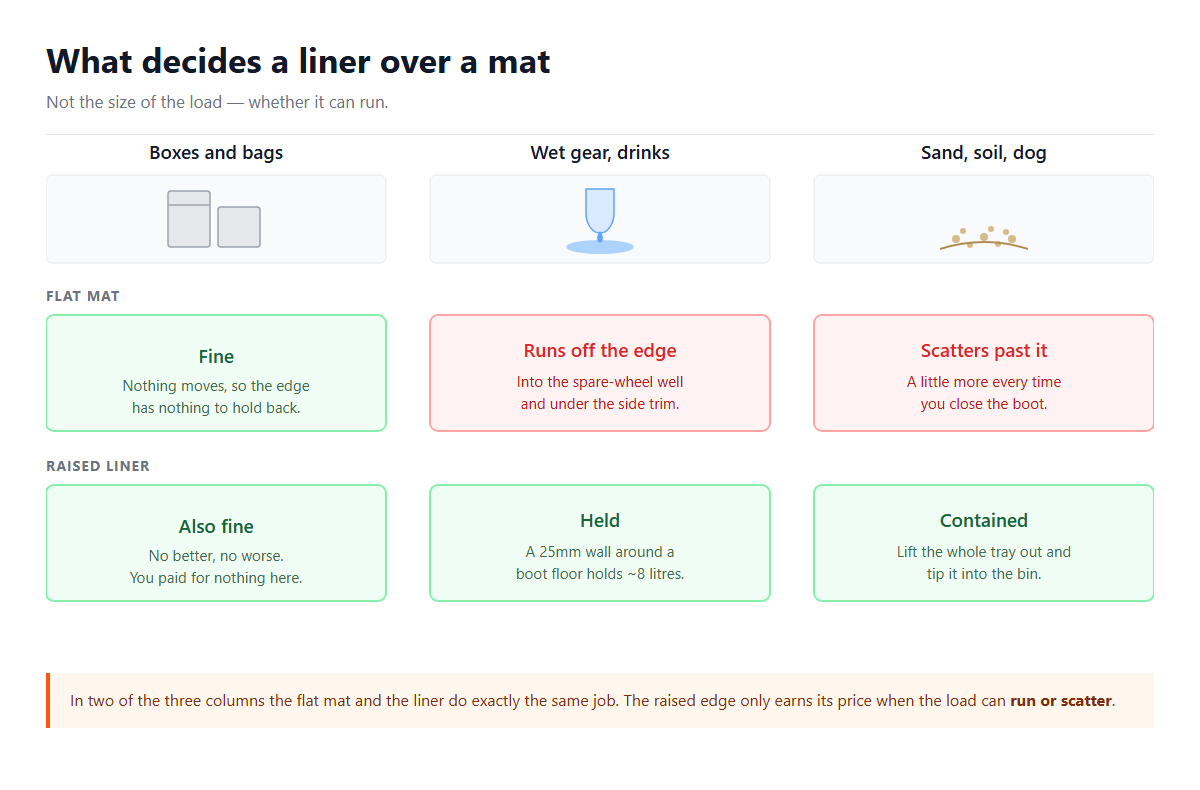
The three cargo types
Solid and contained. Shopping in bags, boxes, luggage, flat-packed furniture. These sit where you put them. A flat mat protects the carpet from scuffing and grit just as well as a liner does, and it is easier to shake out.
Liquid, or capable of becoming liquid. Drinks, wet swimming gear, plants that have just been watered, a chest freezer bag that has started to thaw, anything from a hardware store in a container with a lid. This is where the wall earns its money.
Loose and granular. Beach sand, potting mix, garden waste, a dog that has been anywhere interesting. This material does not need a spill to escape — normal driving and one closing of the boot lid is enough to send it over a flat edge and into the seams around the boot floor.
How much a wall actually holds
The number is worth knowing because it decides whether the liner is a real containment device or just a lip.
A wall of roughly 25mm around a typical mid-size boot floor holds in the order of eight litres. That is a spilled two-litre bottle several times over, or a wet dog shaking itself dry, with margin left. A 10mm lip on the same floor holds closer to three litres, which is a knocked-over coffee and not much more.
So “raised edge” on a product page is not one thing. If the listing does not say the height, look at the side-profile photo — the difference between a genuine wall and a decorative lip is obvious once you know to look.
Where a flat mat is the better buy
Three cases, and they are not edge cases.
You fold the rear seats often. A rigid liner shaped to the seats-up floor becomes an obstacle the moment that floor changes shape. A flat mat can be lifted out in two seconds; a liner has to go somewhere.
You carry long items regularly. Timber, skis, flat-pack boxes that run from the tailgate to the back of the front seats. A wall at the back of the boot floor is something you have to lift every load over.
You want to be able to roll it up. Flat mats store in a fraction of the space. If the mat spends half the year out of the car, that matters more than the containment does.
Side by side
| Flat boot mat | Raised boot liner | |
|---|---|---|
| Spilled liquid | Runs off the edge | Held, roughly 8 litres at 25mm |
| Sand and soil | Escapes into the seams | Contained; lift out and tip |
| Boxes and bags | Fully protected | Fully protected |
| Loading long items | Nothing in the way | Lift over the rear wall |
| Folding rear seats | Lifts straight out | Awkward, needs storing |
| Storing it | Rolls up small | Rigid, needs floor space |
The seven-seat complication
If your car has a third row, there is a second question before this one: which floor is the liner cut for? A seven-seater has two different boot floors depending on whether that row is up or folded, and they are not the same shape. That is covered separately in a seven-seater has two boot floors.
What to check before ordering either
Confirm the build year, because boot floors change with the same mid-cycle revisions that change footwells — see how to check your build year. Check whether the listing covers the underfloor storage compartment, if your car has one; some liners are cut to sit above it and some are not. And look at how the product handles the tailgate sill, which is the part that takes the most scuffing during loading and the part most often left uncovered.
For keeping either one clean once it is in, see boot liner care and the stains that set in. If you carry animals or small children, the cleaning method matters more than the choice above — see three messes, three opposite answers.