


Pets and Kids: Three Messes, Three Opposite Answers
Almost everything that lands on a car mat because of a dog or a child falls into one of three categories. The categories do not share a method. In fact the correct first move for one is the exact thing that ruins another.
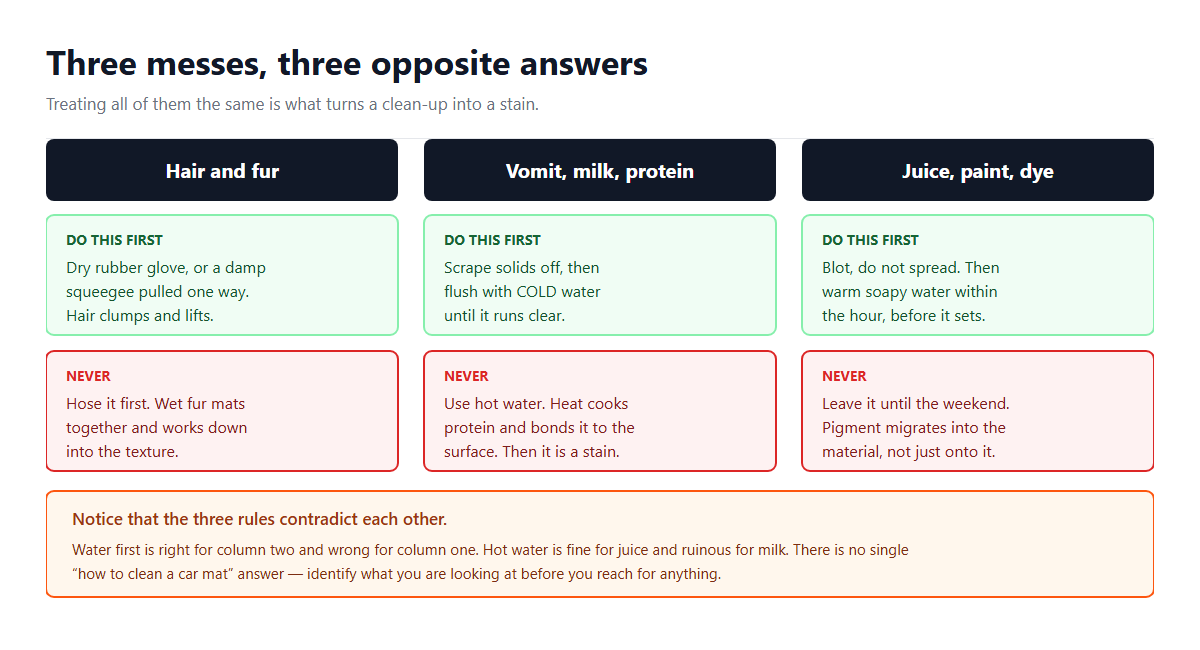
1. Hair and fur
Do this first: a dry rubber glove, or a damp squeegee pulled in one direction. Hair clumps against the rubber and lifts off in a wad you can pick up in one piece.
Never: hose it first. That is the instinct, because water makes most things easier, and it is wrong here. Wet fur mats together and works down into the texture of the mat instead of sitting on top of it. A two-minute job becomes something you pick at with tweezers.
The reason is mechanical. Dry hair sits in the tread pattern with air around it, so a rubber surface has something to grip. Wet hair follows the water down into the grooves and stays there once the water leaves.
2. Vomit, milk and anything protein-based
Do this first: scrape the solids off, then flush with cold water until it runs clear.
Never: use hot water. Heat denatures protein and bonds it to the surface it is resting on. This is the same reason you rinse blood out of clothing in cold water. Once protein has been cooked onto a textured surface it stops being a spill and becomes a stain, and no amount of later washing reverses it.
Note that this directly contradicts the usual advice to wash a mat in warm water. That advice is for road grime, and road grime is not protein.
3. Juice, paint, dye and anything with pigment
Do this first: blot, do not spread. Then warm soapy water within the hour.
Never: leave it until the weekend. Pigment does not sit on the surface waiting for you. It migrates into the material, and once it is in, you are no longer cleaning the mat, you are trying to bleach it — which is its own problem, covered in what not to clean a TPE mat with.
Here the water can be warm, because pigment is not protein. Which is the third contradiction.
The three rules side by side
| Type | First move | Water temperature | How long you have |
|---|---|---|---|
| Hair and fur | Dry glove or one-way squeegee | None — keep it dry | Indefinite. Hair does not get worse. |
| Vomit, milk, protein | Scrape solids, then flush | Cold only | Hours. Smell is the deadline, not the stain. |
| Juice, paint, dye | Blot, do not spread | Warm | About an hour before pigment migrates. |
Why people get this wrong
Because the default cleaning instinct is one method for everything: hose it, scrub it, wipe it. That method is correct for the most common case — mud and road grit — and it is wrong for all three cases above, in three different ways.
The practical version is: identify the category before you touch it. Ten seconds of looking saves an hour of scrubbing.
Where the mat itself matters
All three of these clean up faster on a tray-style mat with a raised lip than on a flat mat, for the same reason: containment. A protein spill on a flat mat has already reached the carpet by the time you find it, and you cannot flush a carpet that is bolted to the floorpan. On a lipped mat the same spill is still sitting in the tray, and the tray can be carried outside.
For a dog specifically, the boot is the more relevant surface, and the choice between a flat boot mat and a raised boot liner comes down to exactly this question of whether what you carry can run or spill. That comparison is in boot liner or boot mat: what your cargo actually decides.
Two things that apply to all three
Take the mat out of the car. Every method above works better outside the vehicle, and two of them are impossible inside it. There is no way to flush a spill properly while the mat is still in the footwell.
Dry it standing on edge. Not lying flat. Whatever is left drains out instead of settling into the lowest point, which is where you were trying to remove something from in the first place.
The full washing routine, once the emergency part is dealt with, is in how to wash TPE and XPE mats without ruining them.
The one case where you should stop
If a protein spill has been in a warm car for more than a day, the smell is bacterial rather than residual, and no amount of surface cleaning will remove it. At that point the mat needs a full soak, and the carpet underneath needs checking too. Trying to solve it with a stronger chemical is the reliable way to end up with a damaged mat and the smell.