


Anchor Types: Why the Same Mat Fits Two Cars and Not a Third
Two cars can share a floor shape and still need different mats, because the thing that holds the mat down is not part of the mat. It is part of the car, and it was chosen by the manufacturer before anyone thought about accessories.
A mat arrives with holes. The car supplies the fixing. If those two do not agree, the mat is loose — and a loose mat is a safety problem, not an inconvenience.
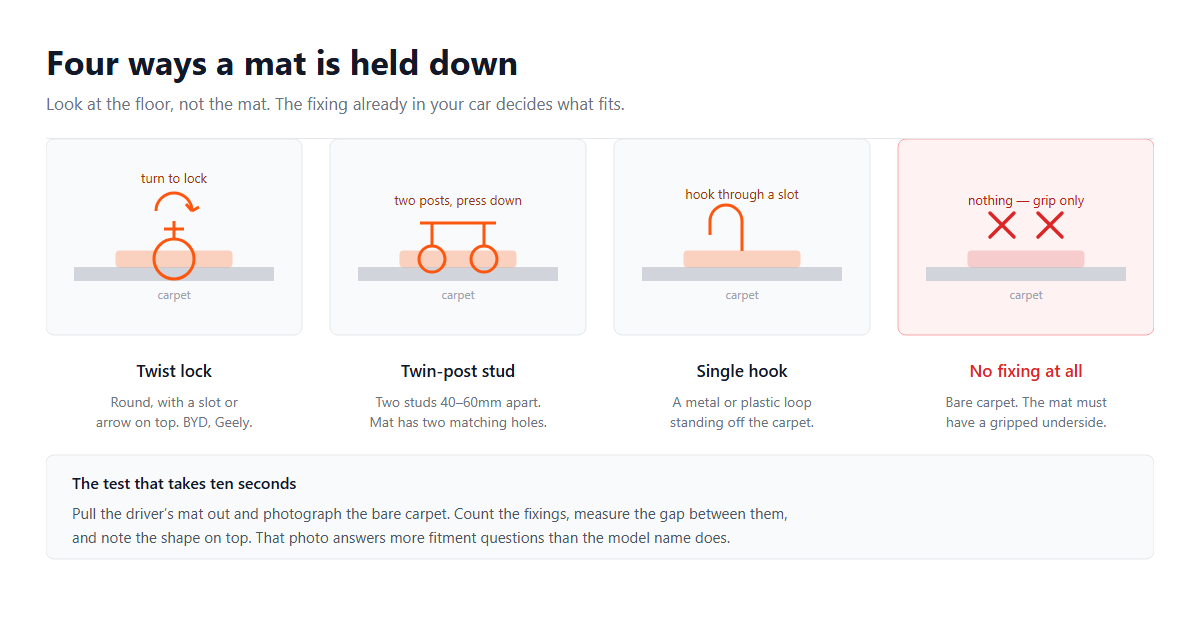
The four types
Twist lock. A round fitting with a slot or arrow on the face. You drop the mat over it and turn the top through 90 degrees to lock. Common on BYD and Geely models. The mat needs a round hole of the right diameter — too small and it will not seat, too large and it spins without locking.
Twin-post stud. Two posts, typically 40 to 60mm apart, that the mat presses down onto. The critical measurement is the spacing, not the post size. A mat made for 50mm spacing will not sit on 60mm posts no matter how flexible it is.
Single hook. A metal or plastic loop standing proud of the carpet, which passes through a slot in the mat. More common on European-designed platforms. The slot has to be in the right place and the right orientation.
No fixing at all. Bare carpet. Here the mat must have a gripped underside — usually a spiked or high-friction backing that holds against the carpet pile. This is the type most likely to be sold with a mat that does not have it.
The check that takes ten seconds
Pull the driver’s mat out and photograph the bare carpet.
Count the fixings. Measure the gap between them if there are two. Note the shape on top. That photograph answers more fitment questions than the model name does, and it costs nothing.
Do this before ordering, not after. It is the single highest-value thing you can do in the two minutes before you click buy.
Why the same model can have different fixings
Three reasons, and none of them are unusual.
Market differences. The same car built for two markets sometimes uses different floor hardware, because the local supplier differs or a local regulation requires a specific retention standard.
Mid-cycle revision. Anchors move or change type when the seat rail or floor pressing is revised. This is one of the commonest reasons a fitment year range ends — see why model years change mid-cycle.
Trim level. Less common, but it happens. A higher trim with different carpet sometimes gets a different retaining system with it.
What to do when the fixing is broken or missing
This is more common than people expect, especially on used cars where a previous owner lost a clip and never replaced it.
| Situation | What is possible |
|---|---|
| Clip cracked, hole in floor intact | Usually replaceable as a part. Ask the dealer for the retainer part number |
| Hole in the floor damaged | Harder. May need a carpet section, which is expensive |
| Hole in the mat elongated | The mat is finished as an anchored item. See five signs your mats have stopped protecting |
| Never had a fixing | Rely on the underside grip; check it is genuinely textured, not smooth |
Why this matters more than it sounds
A mat that can travel forward under braking can reach the pedals. That is the single accessory failure with a genuine safety consequence, and it does not warn you first.
Aftermarket mats sold as universal are the usual culprits, because a generic shape has generic holes that rarely line up with anything — see what one size actually costs you. But a model-specific mat with the wrong anchor type has the same problem, which is why the check above is worth the two minutes.
Before you order
Confirm the build year first — it governs which fixing generation your car has. See how to check your build year. Then match the photograph you took against the product photos. If the seller does not show the underside of the mat, that is worth asking about; the underside is where the answer is.