


Why Model Years Change Mid-Cycle, and Why Nobody Tells You
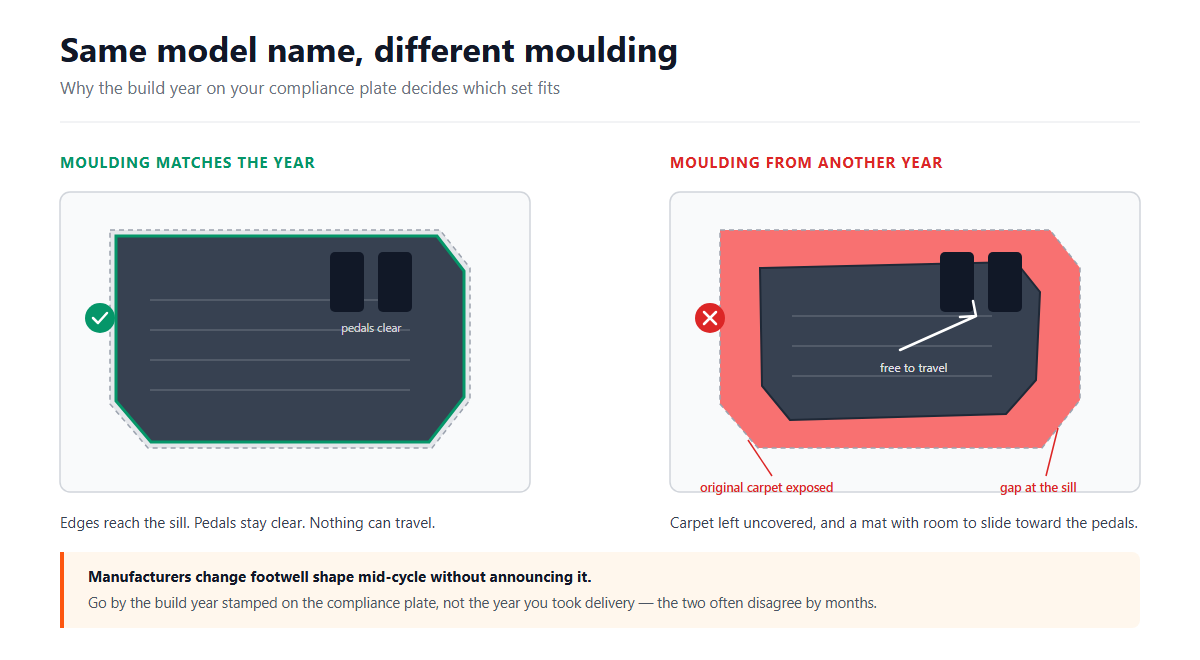
Buy a mat set for a 2023 car and a 2025 car of the same model, and they may be different shapes. The badge is the same. The marketing is the same. The floor is not.
This surprises people, and the surprise is reasonable. Nobody announces it.
What actually changes
Rarely the whole floor. What changes are the details that a moulded mat is cut around:
| Change | Why it happens |
|---|---|
| Anchor point moves | A seat rail or bracket is revised, and the fixing goes with it |
| Console gets wider or narrower | New centre console design, often with the interior refresh |
| Footwell floor is reprofiled | Battery pack or wiring changes underneath |
| Seat rails move | New seat frame, or a change in adjustment range |
Any one of these is enough to make an existing mould wrong. None of them is visible when you sit in the car.
Why it happens more with newer brands
Traditional manufacturers ran long model cycles: a shape for five or six years, one facelift in the middle, and interior changes saved up for that facelift.
The newer electric brands do not work that way. They revise continuously, shipping improvements when they are ready rather than holding them for a scheduled update. That is good for the cars and awkward for anything cut to fit them.
It is not carelessness. It is a different development rhythm, and the accessory catalogue is downstream of it.
Why it is not announced
From the manufacturer's point of view there is nothing to announce. The car still does what the brochure says. The specification sheet does not list footwell geometry, because no buyer has ever chosen a car on that basis.
So the change is real, documented internally as a part number revision, and invisible externally. The first people to notice are usually the ones making accessories for it.
What it means for ordering
Three practical consequences.
Build year is the only reliable input. Not model name, not trim, not what the previous owner bought. See how to check your build year.
A listing that covers 2022-2024 is telling you something. It means the moulding held steady across those three years, and it means a 2025 car is a different item, not an oversight.
Different items can cover different years on the same car. The Denza D9 is the clearest example we stock: seat backs for 2022-2024, boot liner for 2022-2025, mats from 2024. Three items, three ranges, one car.
Is a mid-cycle change a bad sign?
No. If anything it is the opposite. A manufacturer revising an interior mid-cycle is responding to something, usually feedback or a supplier change, rather than waiting three years to fix it.
The cars are better for it. It just means the accessory has to follow the car rather than the name on the boot lid.
Related reading
For the check itself, see how to check your build year before you order. For a car where three build years mean three different mat sets, see the BYD Seal. For how to read what a listing is actually promising, see the words on a car mat listing.