


What Sits Under an EV Floor
Ask why an EV needs a differently shaped mat and the usual answer is that it is a different car. True but useless. The real answer is that the floor above a battery is a fundamentally different structure from the floor above a driveshaft.
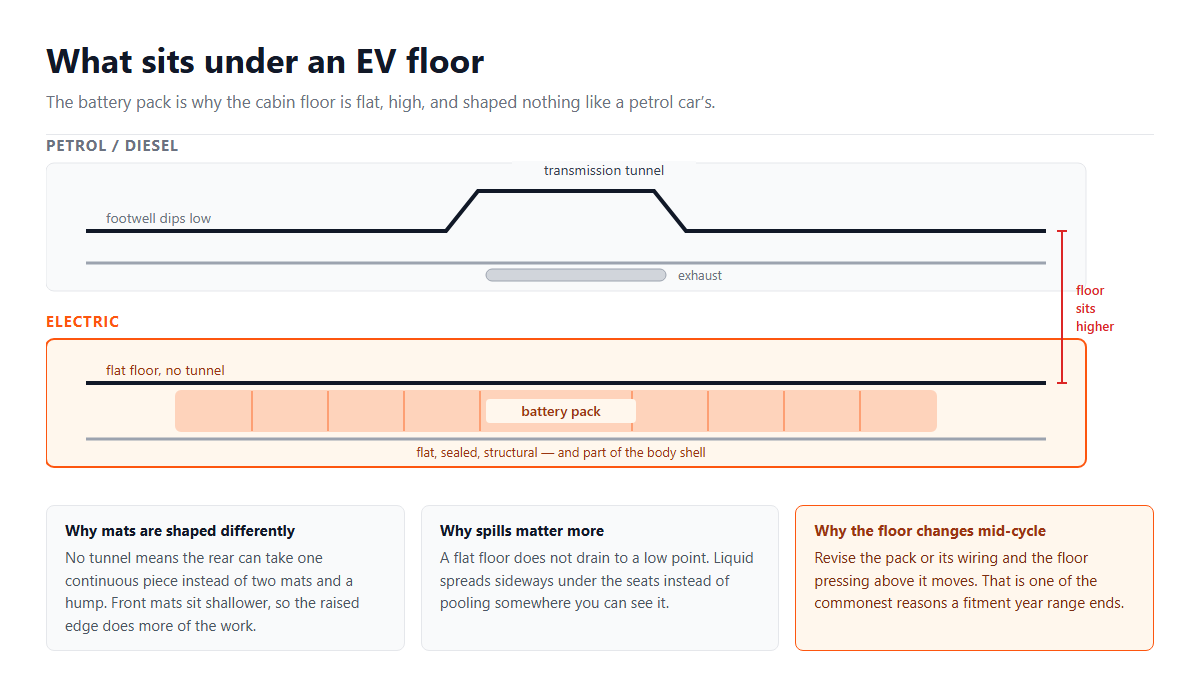
The petrol floor
A combustion car has to route a driveshaft and an exhaust from front to back. Both live under the cabin, and both need clearance, so the floorpan is pressed with a transmission tunnel running down the centre.
That tunnel forces everything else around it. The footwells sit low, in the two troughs either side. The pedals sit at the bottom of a dish. The mat has to be shaped to climb the tunnel wall on one side and drop into the trough on the other.
The EV floor
An electric car has no driveshaft and no exhaust. What it has instead is a battery pack: flat, sealed, and structural — it is part of the body shell, not a component bolted underneath it.
The consequences follow directly. No tunnel, because nothing needs to run through the middle. A flat floor across the full cabin width. And the floor sits higher, because the pack occupies the space where a petrol car has empty air.
Three things this explains
1. Why the mats are shaped differently
A petrol mat is shaped like a shallow trough with a wall. An EV mat is closer to a flat panel with a lip. Neither is a variation on the other, and this is why a mat made for a combustion model of the same nameplate does not fit the electric one, even when the exterior dimensions are almost identical.
It also explains why EV mats often look bigger. They span a floor that no longer has a tunnel dividing it.
2. Why spills matter more
The pack is sealed, so a spill is not going to reach the cells. That is not the issue. The issue is that a flat floor has no low point.
In a petrol footwell, a spill runs to the bottom of the trough and stays there. On a flat EV floor it spreads, and it keeps spreading until it meets something — the seat rails, the sill, the wiring runs and connectors that manufacturers route along the flat floor precisely because it is flat and convenient.
This is the strongest practical argument for a raised lip in an EV. Not to protect the battery, which does not need it, but because there is nothing else on that floor to stop a spill travelling.
3. Why the floor changes mid-cycle
Battery packs get revised more often than body shells. A denser cell chemistry, a different module layout or a new pack supplier can change the pack height by ten or fifteen millimetres, and the floor above moves with it.
From outside, nothing has changed: same badge, same doors, same year. Inside, the mat that fitted last year sits a little proud, or the anchor points have moved. This is the mechanism behind a lot of “it says it fits my model but it does not”, and it is covered from the buying side in why model years change mid-cycle, and why nobody tells you.
Comparison at a glance
| Petrol / diesel | Electric | |
|---|---|---|
| Centre of the floor | Transmission tunnel | Flat, no tunnel |
| Footwell depth | Dips low into a trough | Shallow, sits higher |
| Under the floor | Driveshaft, exhaust, heat | Sealed structural battery |
| Where a spill goes | To the bottom of the trough | Spreads outward, no low point |
| Mat shape | Contoured, climbs the tunnel | Flatter, wider, needs a lip |
Two things that are not true
“EV floors are hotter.” The opposite. A petrol car runs an exhaust under the cabin, and the passenger footwell above it is measurably warmer. An EV floor has no such heat source. If anything, EV footwells are colder in winter, which is why cold-stiffness in a mat matters more, not less.
“You need a special EV mat material.” No. The materials are the same; it is the shape and the fitment that differ. Material choice is decided by climate and use, as set out in TPE, XPE or carpet: how to choose a mat material.
What to check before you order
If your car is electric, two checks matter more than the model name.
- Is the floor genuinely flat across the middle? Some early EVs were built on adapted combustion platforms and kept a vestigial tunnel. Those need a petrol-shaped mat despite being electric.
- Where are the anchor points? A flat floor gives the manufacturer freedom to put them anywhere, and they move between production runs more often than on a combustion car.
Both are answered by looking at the actual car rather than the badge. The generic version of that argument — why a shape that nearly fits is not the same as a shape that fits — is in universal or vehicle-specific: what one-size-fits-all actually costs.