


What Interior Wear Costs at Resale
Nobody buys a used car by inspecting it evenly. There is an order, it is remarkably consistent across buyers, and it is almost the reverse of what things cost to put right.
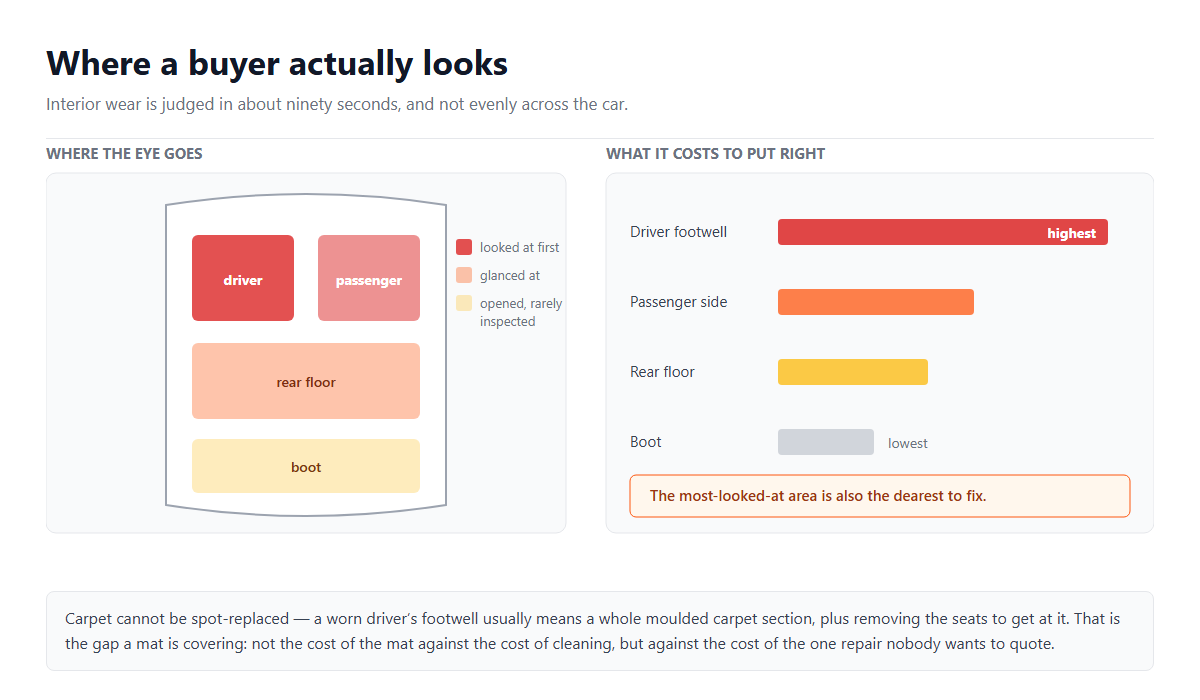
The order buyers actually look in
Watch someone inspect a used car and the sequence barely varies.
- The driver's footwell. They sit in it. They look down at it while adjusting the seat. It gets thirty seconds of direct attention before anything else.
- The front passenger side. A glance, usually from the driver's seat, usually less than five seconds.
- The rear floor. Opened, looked at, rarely touched. Some buyers skip it.
- The boot. Opened to check it opens. Half of buyers never lift the floor panel.
None of this is irrational. The driver's footwell is where they will spend their time, and it is the one area whose condition they can extrapolate from: heavy wear there suggests heavy use everywhere.
The order repairs actually cost in
Now the other side. Restoring an interior is not priced by area — it is priced by how hard the part is to reach and how visible the result must be.
The driver's footwell is the worst case. It carries the pedals, the bonnet release, sometimes the OBD port and a wiring loom. Replacing carpet there is a labour job, not a parts job, and it has to look right because it is the first thing the next buyer looks at.
The boot is the best case. It is a flat panel with clips. It lifts out. A replacement liner is cheap and installs in a minute, and nobody is examining the finish.
So the two orders line up: the most-looked-at area is also the dearest to fix.
What that means in practice
| Area | Buyer attention | Cost to put right | Worth protecting? |
|---|---|---|---|
| Driver's footwell | High — first and longest | High — labour, not parts | Always |
| Front passenger | Medium — a glance | Medium | Yes, comes in the set anyway |
| Rear floor | Low — sometimes skipped | Medium — seats often out | Yes if you carry people |
| Boot | Very low | Low — drop-in panel | Yes, but for different reasons |
The last column is where the argument gets interesting, because the boot is worth protecting for reasons that have nothing to do with resale value. It is worth protecting because what gets spilled back there — paint, garden compost, a leaking bag of shopping — can soak through into the spare wheel well and stay damp for months. That is a smell problem, and smell is the one interior fault that does affect a sale. It is covered separately in boot liner maintenance: getting out the things that soaked in.
Three specific things that cost real money
A heel-worn patch in the driver's carpet
The single most common interior fault in a car over four years old, and the one buyers notice fastest, because they are looking straight at it. It is also unfixable in any cheap way: patching is visible, dyeing is visible, and a full carpet is a day of labour.
A mat prevents it entirely. This is the highest-return protection you can buy, and it is why almost every buying guide starts here rather than with the boot.
A stain the shape of a coffee cup
Small, obvious, and permanent if it went into carpet rather than sitting on top of a mat. Buyers read it as a story about how the car was treated, which is unfair but universal.
A pedal-area smell
Damp that got into the underlay and never dried. Buyers cannot see it, but they can smell it within ten seconds of sitting down, and it kills more sales than any visible wear. This is what a lipped mat is really preventing.
The order to protect in
If budget forces you to stage it, follow the attention column rather than the area count.
- Driver's mat — highest attention, highest repair cost, and the wear starts on day one.
- The rest of the front — usually comes in the same set, so this is not really a separate decision.
- Boot liner — low attention, but the highest risk of a fault that cannot be undone.
- Rear floor — genuinely optional if nobody sits back there.
The same logic applies in reverse when you are the one buying. If the driver's footwell in a used car is clean and the mats look newer than the car, that tells you something specific rather than something vague, and there is a short checklist for it in buying mats for a car you just bought second-hand.
And if the mats already in your car have stopped doing the job, the failure is usually not the one you expect — see five signs your mats have stopped protecting anything.