


Buying Mats for a Car You Just Bought Second-Hand
Ordering accessories for a used car has one extra failure mode that a new car does not: everything you were told about the car came from someone who was trying to sell it, and none of it was written with fitment in mind.
Four checks, in this order. The first one is not optional, because the other three depend on it.
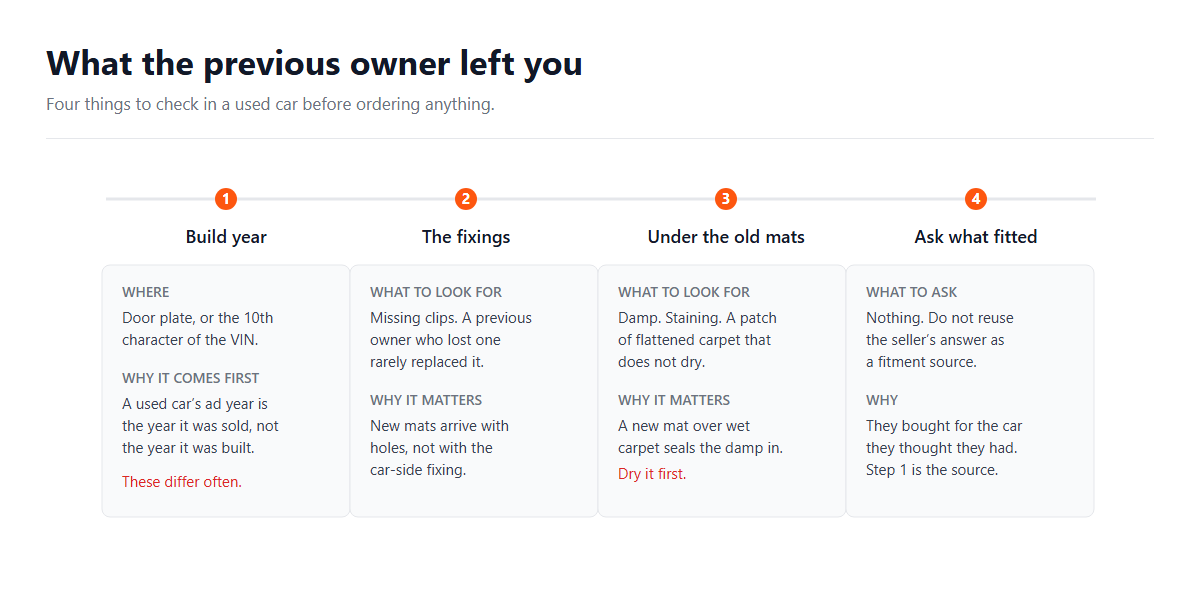
1. The build year, not the ad year
A used car listing states the year it was first registered or sold. The build date can be earlier — sometimes by a few months, sometimes by more than a year if the car sat on a dealer lot through a model changeover.
This matters because fitment ranges follow build dates, not registration dates. A car advertised as a 2024 that was built in late 2023 may take the earlier mat.
The compliance plate in the door aperture gives you the build month and year directly. Failing that, the tenth character of the VIN encodes the model year. Full method in how to check your build year.
2. The fixings, and whether they are all still there
Pull out the existing mats and count the anchor points on the bare carpet. On a used car, expect to find at least one missing or broken. A previous owner who lost a clip almost never replaced it, because the mat still mostly stayed put and it stopped being noticeable.
New mats arrive with holes, not with the car-side fixing. If the fixing is gone, a new mat will be just as loose as the old one. Ask the dealer for the retainer part number before you order the mats — it is usually a few dollars, and it is the difference between a mat that stays and one that travels.
The four types and how to tell them apart are covered in anchor types.
3. What is underneath the old mats
This is the check people skip, and it is the one that costs money later.
Lift the mats out and look at the carpet. You are looking for three things:
| What you find | What it means |
|---|---|
| Damp, or a patch that stays cool to the touch | Water is getting in from somewhere. A new mat over it seals it in |
| Flattened, discoloured patch at the heel | The previous mats were the wrong fit and left that spot exposed |
| Staining around the anchor points | Normal, or a sign the mat was moving. Check the anchors again |
If the carpet is damp, find out why and dry it before fitting anything. A moulded mat over wet carpet does not let it dry — it holds the moisture against the floor pan indefinitely, and that is how a small leak becomes a rust problem.
4. Do not use the seller as a fitment source
This sounds cynical but it is not about honesty. The previous owner bought accessories for the car they believed they had, using the same advertised year that is now confusing you. If they got it wrong, buying the same thing repeats their mistake.
The same applies to mats left in the car at handover. They are evidence of what someone bought, not evidence of what fits. Measure them against the footwell before assuming anything.
What a used car changes about the choice itself
Two things worth thinking about.
The carpet may already be worn. If the driver’s footwell has visible wear, a mat is now damage limitation rather than prevention. That is still worth doing — it stops the wear getting worse and it matters at your resale, not the last owner’s. See what interior wear actually costs at resale.
You may not know the car’s history. A car that spent three years at a beach or on a farm has ground-in material in the carpet pile that a new mat will sit on top of. Vacuum thoroughly before fitting, or the grit works upward into the new mat’s underside and abrades it from below.
The short version
Build year from the plate or VIN. Photograph the bare carpet. Dry anything damp. Then order, using your own measurements rather than the previous owner’s decisions.
For reading what a listing actually promises once you have those facts, see the words on a car mat listing. For deciding what to replace first if the interior needs several things, see what to buy first.