


What Not to Clean a TPE Mat With
Most advice about cleaning car mats is about technique. This article is about the shelf. Three products that sit in almost every garage will quietly destroy a TPE or rubber mat, and two of them are marketed specifically for cars.
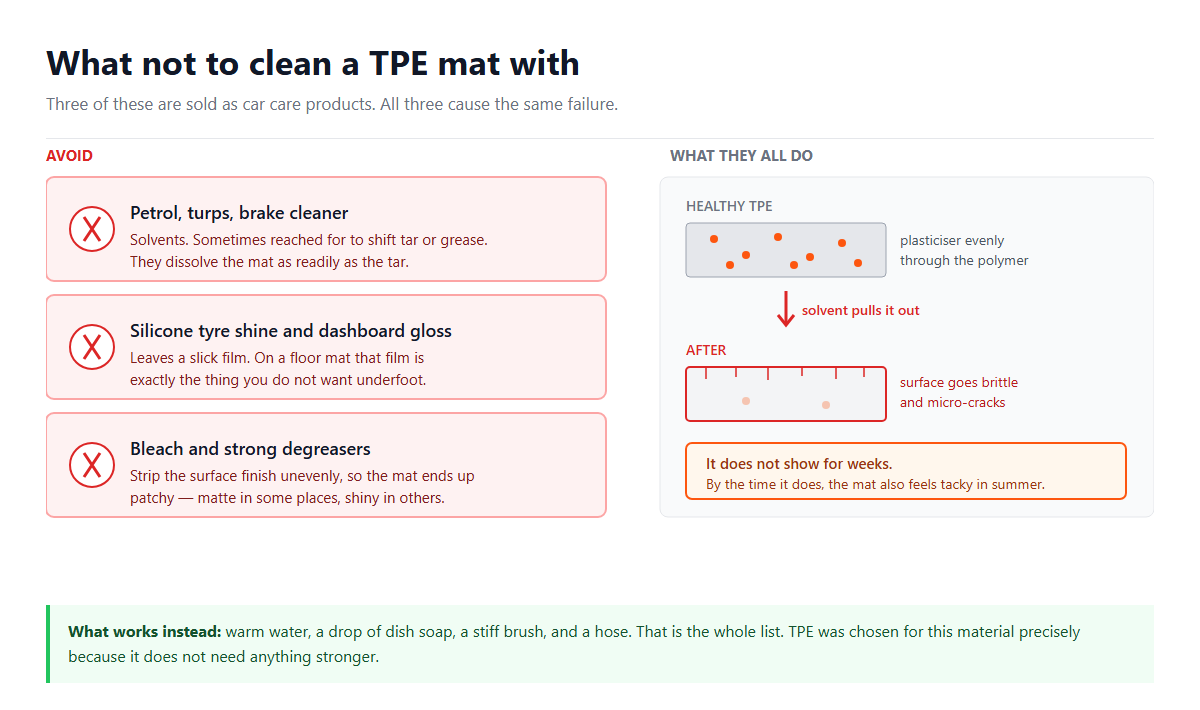
1. Solvents
Petrol, turpentine, brake cleaner, acetone, paint thinner. These get reached for when something genuinely stubborn lands on the mat — road tar, chain grease, adhesive residue.
They work. That is the problem. A solvent that dissolves tar does not distinguish between the tar and the polymer underneath it. TPE is a thermoplastic elastomer; strong solvents soften it on contact and take material with them when they evaporate. What you see immediately is a slightly dull patch. What you get later is a patch that stays permanently softer than the rest of the mat and collects dirt faster.
2. Silicone tyre shine and dashboard gloss
This one is applied deliberately, not in an emergency, and usually with good intentions: the mat looks faded, the bottle promises restored blackness, so it goes on the mat.
Two separate problems follow. The first is immediate and is a safety issue: silicone dressings leave a slick film. On a dashboard that film is harmless. On the surface your right foot pushes against, it is exactly the thing you do not want. A shoe that slides on the mat is a shoe that can slide off a pedal.
The second problem is slower. Most spray dressings carry the silicone in a solvent so it can wet the surface and flash off. That carrier does the same thing petrol does, just more gently and over more applications.
3. Bleach and strong degreasers
Chlorine bleach, oven cleaner, wheel cleaner, undiluted alkaline degreaser. These attack the surface finish rather than the bulk of the material, and they do it unevenly, because they sit where they land and run where they run.
The result is a mat that ends up patchy — matte in some places, shiny in others — in a pattern that has nothing to do with where you actually put your feet. Once the finish is stripped in a stripe, no amount of later cleaning evens it back out.
What all three actually do
TPE gets its flexibility from plasticiser distributed evenly through the polymer. That is what lets a mat lie flat in a cold footwell instead of behaving like a sheet of hard plastic.
Every product above pulls plasticiser out. Solvents do it fast, dressing carriers do it slowly, degreasers do it at the surface. The polymer that is left has the same shape and less of what made it flexible.
Three symptoms follow, in this order:
- Nothing, for weeks. This is why the habit persists. The bottle appears to have worked.
- Micro-cracks. Usually first at the heel pad and along the raised lip, because those are the parts that flex most.
- Tackiness in summer. Counter-intuitive, but characteristic: a mat that has lost plasticiser unevenly goes sticky in heat rather than staying dry. If your mat has started grabbing at shoe soles on hot days, look at what has been used on it.
Quick reference
| Product | Why people use it | What it does to TPE |
|---|---|---|
| Petrol, turps, brake cleaner | Shifting tar or grease | Dissolves the mat as readily as the tar. Permanent soft patch. |
| Silicone tyre shine | Restoring a faded look | Slick film underfoot, plus slow plasticiser loss from the carrier. |
| Bleach, oven or wheel cleaner | Stubborn stains | Strips the finish unevenly. Permanently patchy appearance. |
| Pressure washer at close range | Speed | Not chemical, but will lift edge welds and force water into the backing. |
What works instead
Nearly everything a car mat encounters comes off with warm water and a neutral pH detergent — dish soap is fine — and a medium-stiff brush. The brush matters more than the chemical. Grit sits in the tread pattern, and the job is mechanical, not chemical.
Rinse thoroughly, because detergent left in the tread is the reason some mats look dusty a week after cleaning. Dry standing on edge rather than flat.
The full routine, including how often it is worth doing, is in how to wash TPE and XPE mats without ruining them.
The genuine exceptions
Two things do not come off with soap.
Road tar. Use the smallest possible amount of citrus-based tar remover, on a cloth rather than on the mat, then wash the area immediately with detergent to remove the remover. Never let it sit.
Dried road salt. No chemical is needed, and adding one makes things worse. Salt needs volume of plain cold water and repetition, which is a different problem with a different answer: why road salt does its damage after it dries.
One more thing that is not a cleaning problem
If a mat has gone stiff or will not sit flat, the instinct is to assume it needs conditioning with something. It almost never does. Stiffness is usually storage: a mat kept rolled or folded holds the shape it was kept in. That is covered in how to store a mat set without ruining the fit, and the fix costs nothing.