


Why Road Salt Does Its Damage After It Dries
Most people clear winter slush out of a car when it is convenient, which usually means once it has dried and stopped making a mess. That is exactly backwards.
Salted slush is at its least harmful while it is still wet. The damage starts when the water leaves and the salt stays.
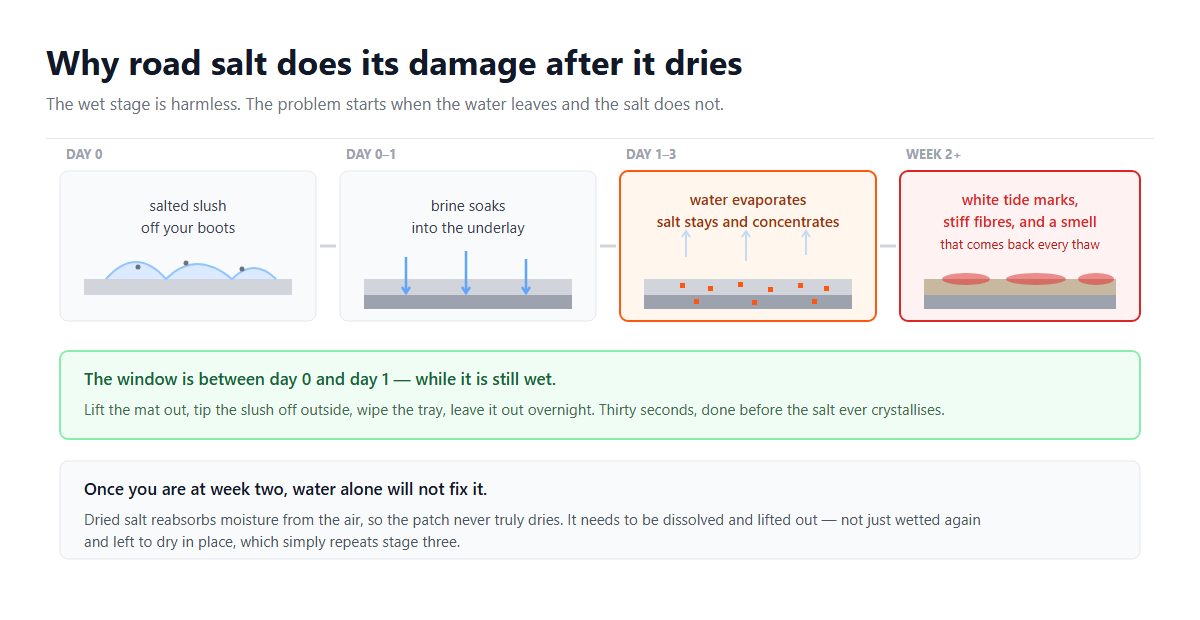
What is actually happening
Day 0. Salted slush comes off your boots and lands on the mat. Right now it is a dilute brine, and everything about it is reversible. A wet cloth would end the story.
Day 0 to 1. If the mat has no raised edge, or the edge has curled, the brine runs off the side and soaks into the carpet and the underlay beneath it. This is the point at which the easy fix stops being available.
Day 1 to 3. The water evaporates. The salt does not. Whatever was dissolved in that puddle is now sitting as crystals in the same square of carpet — and the concentration has gone up, because the solvent left and the solute did not.
Week 2 onward. Dried road salt is hygroscopic: it pulls moisture back out of the air. So the patch never truly dries. It re-wets itself on humid nights, dries again, and each cycle pushes a white tide mark a little further out. The fibres stiffen. The smell returns with every thaw.
Why dry is worse than wet
Three things change when the water goes.
Concentration. A litre of slush might be two per cent salt. Evaporate the litre and you have not removed the salt — you have turned it into a saturated deposit. Chemistry that was mild at two per cent is not mild at forty.
Hygroscopy. Salt does not sit there inertly. It draws water vapour out of cabin air and holds it against whatever it is resting on. A carpet patch with dried salt in it stays measurably damper than the carpet around it, for months, without anyone spilling anything.
Abrasion. Dried salt is crystalline and sharp. Every time a shoe lands on it, those crystals are ground into the fibre and into the surface of whatever mat is underneath. On a rubber or TPE mat this shows up as a dulled, scuffed patch in the heel area long before the mat is worn anywhere else.
What to do, by stage
| Stage | What you see | What still works |
|---|---|---|
| Day 0 | Wet grey slush sitting on the mat | Anything. Tip it out, wipe it, ignore it for an hour. Fully reversible. |
| Day 1 | Damp mat, carpet edges darkening | Remove the mat and flush with cold water. Still easy. |
| Day 3 | White powdery edges, stiff fibres | Repeated flood-and-tip. Works, but takes three or four rounds. |
| Week 2+ | Tide marks, smell on humid days | Wet extraction or a professional clean. The mat itself is usually fine; the carpet under it may not be. |
The rinse that actually works
Salt is water-soluble, which sounds like good news and mostly is. The catch is that a damp cloth does not remove salt, it redistributes it. Wiping a dried salt patch with a wet cloth dissolves the crystals, spreads the brine over a wider area, and then that wider area dries out with salt in it. You have made the stain bigger.
The method that works is dilute and lift, repeated:
- Take the mat out of the car. This is not optional. You cannot flush salt out of a carpet that is still bolted to a floorpan with electronics under it.
- Flood it with plain cold water. Not a spray — a genuine flood, so the salt has somewhere to go.
- Tip the water off. Do not wipe it off.
- Repeat at least twice more.
- Dry it standing on edge, not lying flat, so whatever is left drains out instead of settling in the lowest point.
Cold water, not hot. Hot water dissolves salt faster, but it is also better at driving it deeper into a carpet backing, and on a rubber or TPE mat repeated hot rinses accelerate plasticiser loss. The full washing routine, including what to do about the mat surface itself, is in how to wash TPE and XPE mats without ruining them.
What a mat can and cannot do
None of this prevents salt entering the car. Nothing does, short of not driving in winter. What a mat changes is where the salt ends up and how long you have to act.
A flat mat with a stitched or flush edge holds no liquid at all. Brine arrives, spreads across the surface, reaches the perimeter within a minute or two and goes over the side. Day 0 and Day 1 happen in the same afternoon.
A tray-style mat with a raised lip — even a 15 to 20 mm one — changes the arithmetic completely. The brine is contained. It cannot reach the carpet unless the volume exceeds the tray, which for melted footwell slush it essentially never does. The salt is still in your car, but it is sitting on a surface you can carry outside and tip into a drain.
That is the whole practical argument for a lipped mat in a salted climate, and it is worth being precise about it: the lip does not stop the salt. It buys you the window.
Where the lip usually fails
Two failure modes, both common.
The heel pad end. Many mats taper the lip down to nothing at the driver’s heel so the pedal box stays clear. That is a legitimate design decision, but it means the lowest point of the tray is also the open end. Park nose-down on a slope and the contents run out at exactly that point.
Cold-set curl. A mat stored rolled, or shipped rolled and never properly flattened, keeps a memory in the lip. In summer it relaxes. In a cold footwell it stays curled, and a curled lip is a ramp. Cold makes both TPE and XPE stiffer and slower to recover, which is covered in what heat and cold actually do to TPE and XPE mats. If the edge of your mat is not sitting flush against the carpet in January, the tray is not a tray.
Both are worth checking before the first freeze rather than after it.
What not to reach for
The instinct when facing a white salt tide mark is to attack it with something stronger than water. Almost every “something stronger” on a household shelf is worse for a rubber or TPE mat than the salt was. That is a longer subject with its own article: what not to clean a TPE mat with, which covers the three products that do the most damage and the single mechanism they share.
The short version for salt specifically: plain cold water removes it completely, given enough volume and enough patience. Nothing needs to be added.
End of the season
When the salt trucks stop running, give the set one proper flush before it goes into storage or back under the seats. Salt left in a mat over a warm summer does not go anywhere. It waits, and the first humid week reactivates every bit of it.
How the set is stored matters more than most people expect — a mat folded across a cold-set crease can hold that crease permanently. That is covered in how to store a mat set without ruining the fit.