


How to Store a Mat Set Without Ruining the Fit
Most mats that stop fitting were never worn out. They were put away badly for one season and came back with a shape they did not have before.
The thing that decides whether a stored mat recovers is not how long it sat in the cupboard. It is how tightly it was bent while it sat there.
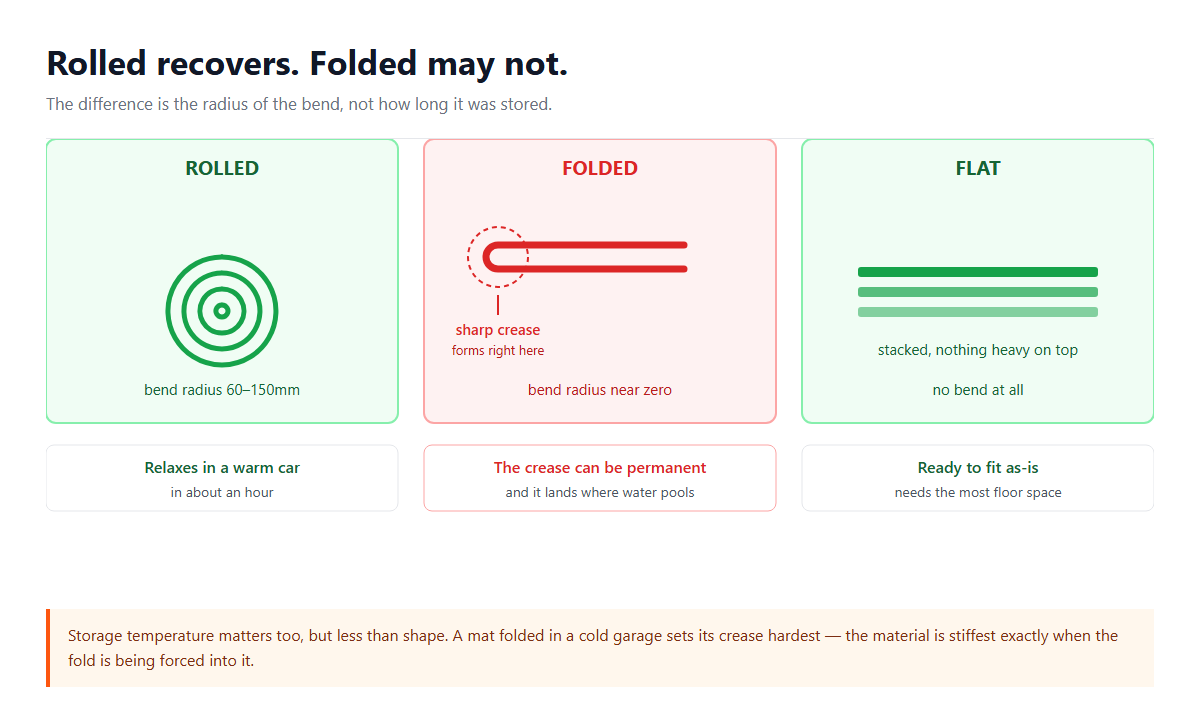
Rolled: recovers
Rolling a mat around itself gives a bend radius of roughly 60 to 150 mm, depending on how loosely you roll it. At that radius the polymer is bent but not yielded. Warm it up and it comes back.
In practice that means leaving it flat in a warm car or a warm room for about an hour. Nothing else is required. No weights, no heat gun, no conditioning product.
Folded: may not
A fold puts the bend radius near zero at a single line. All of the strain that a roll spreads over a wide arc is concentrated into one crease a few millimetres wide.
Sometimes that crease relaxes. Sometimes it does not, and the reason it matters is where it lands. A folded mat is almost always folded across the middle, which is the low point of the footwell, which is exactly where water collects. A permanent crease there is a channel that carries liquid to the edge instead of holding it.
If the fold is going to be permanent, you will not know for weeks. That is why the rule is simply not to fold.
Flat: ideal, and inconvenient
Stacked flat with nothing heavy on top is the only method with no bend at all. It is also the one that needs the most floor space, which is why almost nobody does it.
If you do stack, stack same-shaped mats together and keep the pile shallow. A heavy object left on a stack for a season produces a dent that behaves exactly like a crease.
Quick comparison
| Method | Bend radius | What happens after storage |
|---|---|---|
| Rolled | 60–150 mm | Relaxes flat in a warm car in about an hour. |
| Folded | Near zero at the crease | The crease may be permanent, and it lands where water pools. |
| Flat, stacked | None | Ready to fit as-is. Needs the most space. |
| Hung over a rail | Small, at one line | Same problem as folding, plus stretch under its own weight. |
Where you put it matters as much as how
Cold. An unheated garage in winter is the worst place to store a rolled mat, because the material is stiffest exactly when it is being asked to hold a curve. Cold does not damage TPE or XPE, but it slows recovery to the point where a roll can set. This is the same mechanism described in what heat and cold actually do to TPE and XPE mats.
Sunlight. Direct sun through a window over a whole summer will fade one side of a mat and leave the other untouched. Store it face down, or covered.
Weight. Anything stacked on top for months leaves a mark. A toolbox is enough.
Damp. A mat put away wet is not damaged by the water, but anything trapped underneath it will not dry. If you are swapping a winter set out, wash and dry it fully first — road salt left in the tread reactivates on the first humid week.
The seasonal swap
If you run two sets, the changeover is the moment when most damage happens, because the set coming off is dirty and the set going on is needed immediately.
Do it in this order: remove, wash, dry standing on edge, then roll loosely and store. The temptation is to fold the dirty set into a bag and deal with it later, and that is exactly how a set comes out of storage with a crease in it.
Note that washing means water and neutral detergent only. The products people reach for at changeover — degreasers, dressings, solvents — do more harm than the season did, which is covered in what not to clean a TPE mat with.
If it already has a crease
Try this before assuming the mat is finished.
- Lay it flat in a warm place. A closed car in the sun is ideal, and better than a heated room because the heat is even.
- Leave it for a full afternoon, not twenty minutes.
- Check by eye at a low angle rather than by feel. A crease that has released will disappear from a shallow viewing angle.
- If it is still visible after two attempts, it is set. The mat still works, but treat the crease as a drainage line rather than expecting it to hold liquid.
Do not try to speed this up with a heat gun, boiling water, or an iron. Localised heat softens one small area far past where the rest of the mat is, and the result is a shiny patch that never matches again.
A new mat that will not lie flat
This is a different situation with a different answer. A mat that arrives rolled in a box has been in that roll for days or weeks, not months, and it almost always flattens on its own within the first hour. What is normal on arrival and what is worth raising is covered in why mats arrive rolled, and what the first hour should look like.