


A 35°C Day Is Not a 35°C Car
Every summer article about cars starts with the forecast temperature. The forecast describes air in the shade, moving, measured about 1.2 metres above the ground. A parked car is none of those things.
What the numbers actually are
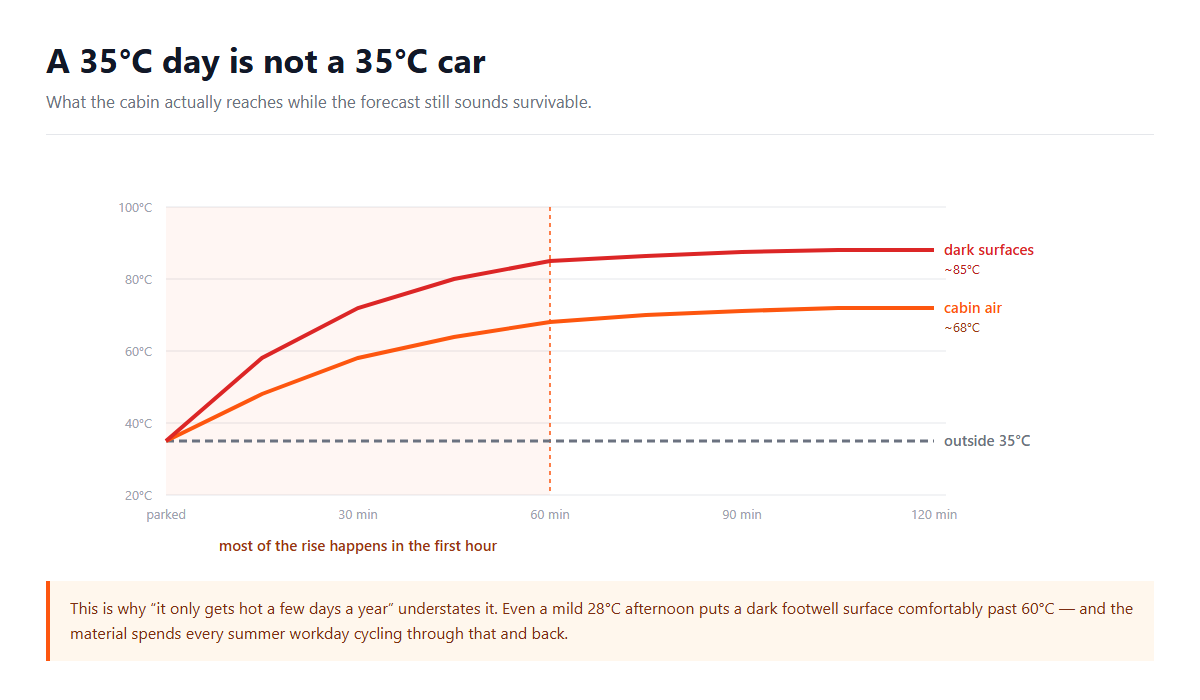
On a 35°C day, a car parked in full sun reaches roughly 68°C of cabin air and around 85°C on dark interior surfaces — the dashboard top, a black seat, and the mat in the driver’s footwell if the sun is falling on it.
The shape of the curve matters more than the peak. Most of the rise happens in the first hour. By thirty minutes the cabin is already most of the way to where it will end up. Parking for “just a quick errand” does not avoid this; it lands you in the steepest part of the climb.
Why the interior gets hotter than the air outside
Glass passes short-wave solar radiation inward easily. That radiation hits the interior surfaces and is re-emitted as long-wave infrared, which glass passes much less easily. The energy comes in faster than it leaves.
Air is not the thing absorbing it. The surfaces are. That is why dark surfaces run 15 to 20°C above cabin air: they absorb more of the incoming radiation and hold it. A thermometer clipped to the mirror measures air and understates what the plastics are experiencing.
What this means for what is on the floor
An 85°C surface temperature is not damaging to TPE or XPE as such. Both handle it. What it changes is behaviour:
- Softening. A mat that is rigid at 10°C is noticeably pliable at 60°C. If it is going to conform to a shape it is being pressed into, this is when it happens.
- Odour. Any volatile still in the material comes off faster in heat. This is why a new mat smells strongest after its first hot day, not on arrival.
- Anything left on top. A mat pinned under a heavy object through a hot afternoon takes the impression of that object, because the material is at its softest exactly when the load is on it.
The full material picture, cold end included, is in what heat and cold actually do to TPE and XPE mats.
Where each material sits
| Material | At ~85°C surface | Practical consequence |
|---|---|---|
| TPE | Softens, fully recovers on cooling | Will take a shape if held in one. Otherwise unaffected. |
| XPE | Softens more, recovers more slowly | More prone to holding an impression from a heavy load. |
| Carpet | Unaffected structurally | Backing adhesive is the weak point, not the pile. |
| Vinyl / PVC | Softens and can go tacky | The material most likely to mark or transfer colour. |
The three practical consequences
1. Do not leave anything heavy on a mat in summer. Not a toolbox, not a case of drinks, not a folded pram. Six hours at 70°C with weight on it is exactly the recipe for a permanent dent.
2. Spills behave differently. Sugary drinks caramelise instead of drying, and protein spills are effectively being cooked. The urgency of cleaning up goes up in summer, and cold water becomes more important, not less.
3. New mats flatten faster. The one genuinely useful thing about the heat. A mat that arrived rolled will relax in a closed sunlit car in well under an hour.
What the heat does not do
It does not warp a properly fitted mat by itself. Heat plus an unsupported shape does that. A mat lying flat on the floorpan has nothing to deform into and comes through summer unchanged.
It also does not justify reaching for a “protectant” spray. Interior dressings do nothing about temperature, and most of them harm the mat more than the heat does — see what not to clean a TPE mat with.
If you are choosing a mat for a hot climate
Temperature is rarely the deciding factor, because all the common materials tolerate the range. Fit, edge height and anchoring matter more. But two things are worth weighting:
Colour. A black mat in a sunlit footwell runs hotter than a grey one. Not enough to damage anything, enough to notice under bare feet or thin soles.
Recovery speed. If the car is parked outside year-round, a material that returns to shape quickly after softening is worth more than a marginally tougher one. The comparison is in TPE, XPE or carpet: how to choose a mat material.
The number worth remembering
Not 85. The useful number is one hour — the window in which most of the temperature rise happens. It is the reason a windscreen shade put up at the start of a stop works and one put up halfway through mostly does not.