


Why Mats Arrive Rolled, and the First Hour
Mats ship rolled because rolling is the only way to move a shaped panel without creasing it. Folding would put a permanent line across the middle. Rolling puts a temporary curve along the whole thing, and a curve relaxes.
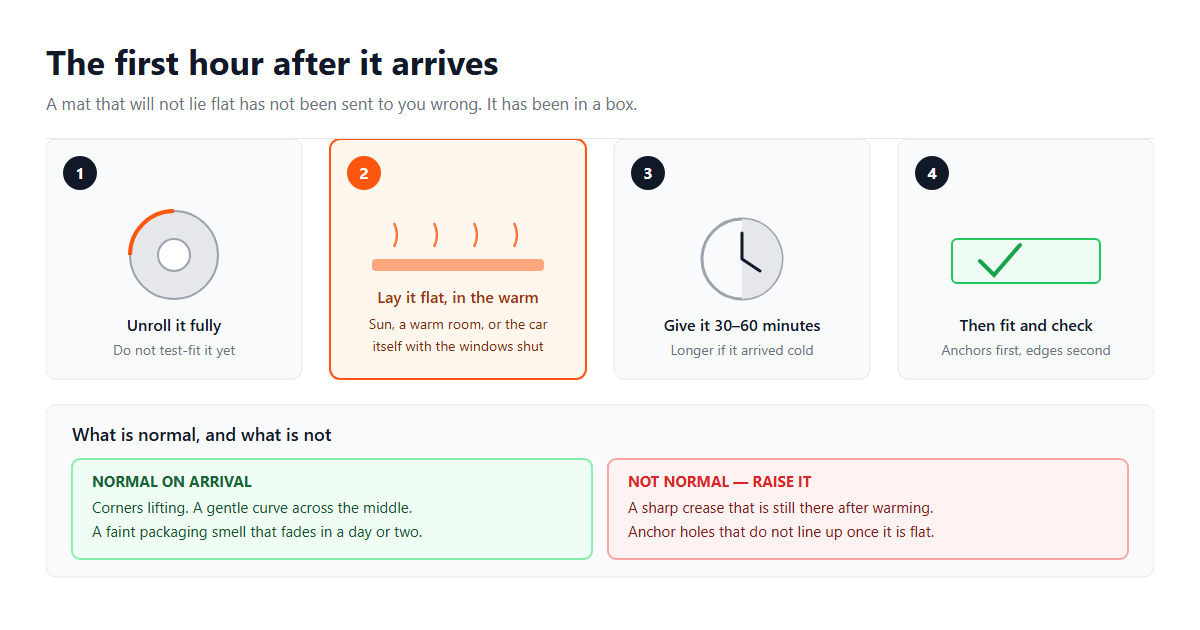
The first hour, in order
- Unroll it completely. Not partly. A mat left half-rolled while you do something else keeps the memory in the rolled half.
- Lay it flat, upside is up, somewhere warm. Indoors is fine. A driveway in the sun is faster. A cold garage floor is the slowest possible choice.
- Leave it thirty to sixty minutes. TPE and XPE both relax with warmth, and they relax on their own. Nothing needs to be weighted or forced.
- Fit it, checking the anchors first. Line up the anchor holes before you worry about the edges. If the anchors sit right, the edges almost always follow.
That order matters. Fitting a mat that is still curved and then judging the fit is how people conclude they were sent the wrong part.
Normal, and not normal
| Normal on arrival | Not normal after warming |
|---|---|
| Corners lifting off the floor | A sharp crease that stays a crease |
| A gentle curve across the whole mat | Anchor holes that do not line up when the mat is flat |
| A faint packaging smell | A visible split or thinned area at a fold |
| Slight stiffness in cold weather | Edges that will not sit down after an hour warm |
The left column is packaging. The right column is a fault or a fitment mismatch, and the difference between the two is simply whether an hour of warmth changed anything.
Three things not to do
Do not use a heat gun or hot water. Warm is enough. Hot deforms the shaped areas permanently, and the shaped areas are the whole point of a vehicle-specific mat.
Do not roll it the other way. It feels logical and it works against you: you are adding a second set of stresses instead of letting the first one relax.
Do not stack heavy objects on it to flatten it. Weight on a curved panel creates pressure points, and pressure points are where creases start.
If the anchors are the problem
Anchor holes that will not line up on a genuinely flat mat are not a relaxation problem, and no amount of waiting fixes them. Either the mat is for a different production run, or your car has a different retainer type from the one assumed. Which of the two it is can usually be settled in ten seconds — see retainer types: why one mat fits two cars and not a third.
After the first hour
Once a mat has been flat for a day it holds that shape, and from then on the thing that ruins the fit is storage rather than use. A set that comes out of the car for a weekly clean and goes back in flat will still fit in three years. A set folded into a boot corner will not.
The bend radius, not the storage time, is what decides that — the reasoning is in how to store a mat set without ruining the fit.
And if a mat that once fitted has stopped sitting down properly, that is a different signal entirely, usually one of the five in five signs your mats have stopped protecting anything.